Dang Gui 當歸
Angelicae Sinensis Radix
Drug part: ROOT
Angelica sinensis (Oliv.) Diels
synonym別名: A. polymorpha Maxim. var. sinensis Oliv. 變種中華橄欖。
PLANT DESCRIPTION 植物描述
Long established as a medicinal crop in China with many cultivars grown (Zhang et al., 2012a). Their descriptions may depart slightly from the below of the wild species. 在中國長期以來作為藥用作物種植,種植了許多品種(Zhang 等人,2012a)。它們的描述可能與下面的野生物種略有不同。
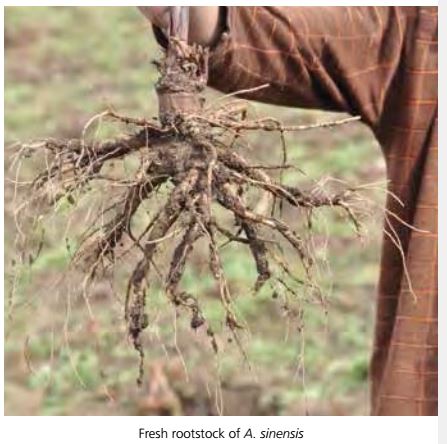
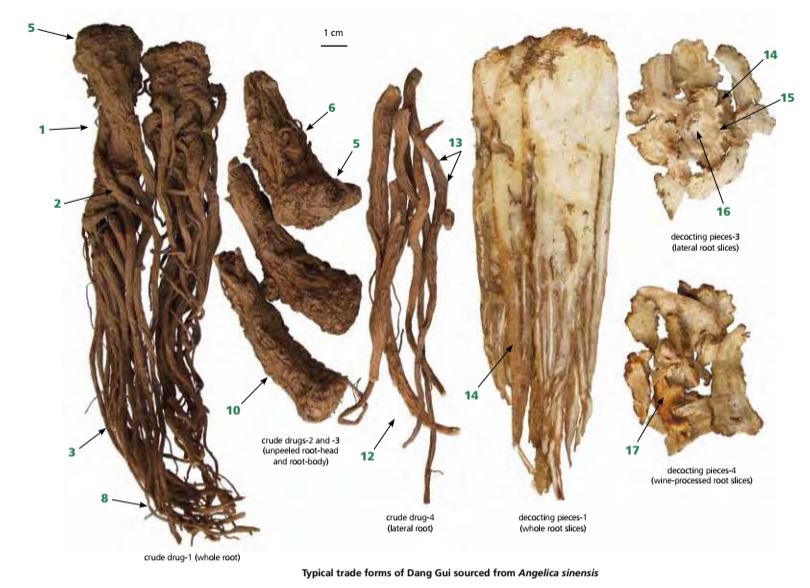
An erect perennial herb (40–100 cm tall) with a stout, many-branched and aromatic taproot (= medicinal part ‘Dang Gui’). 直立的多年生草本植物(40-100公分高),具有粗壯、多分枝且芳香的主根(=藥用部分「當歸」)。
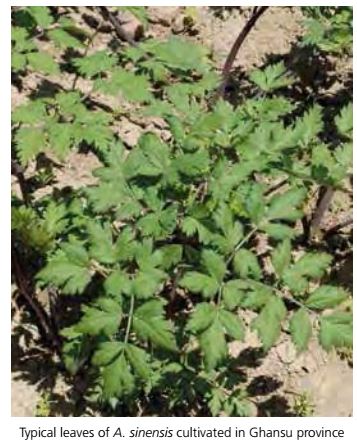
Stem single, branched and ribbed. Leaves alternate; basal and lower leaves with inflated sheaths; lowermost leaves 2–3-ternate-pinnate (10–30 cm long; 12–25 cm wide); pinnae 3–4 pairs; leaflets ovate to ovate-lance-shaped, widest below middle (2–3.5 cm long; 0.8–2.5 cm wide), margins irregularly and sharply toothed; upper leaves 1-pinnate.
莖單生,分枝,具稜。葉互生;基生葉和下部葉具膨大的鞘;最下部的葉2-3回三出羽狀(10-30公分長;12-25公分寬);羽片 3-4 對;小葉卵形至卵狀矛狀,中部以下最寬(長2-3.5公分;寬0.8-2.5公分),邊緣不規則且有銳齒;上部葉1羽狀。
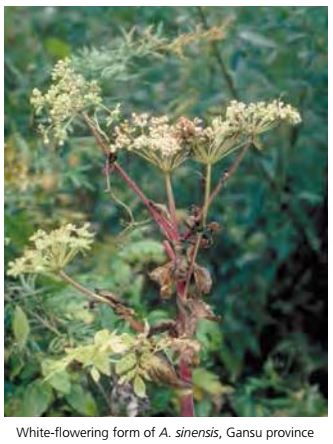
Inflorescences many, in terminal or lateral compound umbels; main umbel with 10–30 rays; bracts absent or 2, linear; each umbellet 13–36-flowered; bracteoles 2–4, linear (3–5 mm long).
花序多數,為頂生或側生的複繖形花序;主繖形花序有10-30條射線;苞片無或2,線形;每個繖形花序13-36花;小苞片 2-4,線形(3-5 公厘長)。
Each flower: calyx absent; petals 5, white, sometimes pink-purplish, equal; styles 2.
每朵花:無花萼;花瓣5,白色,有時帶有粉紅色的紫色,等長;花柱 2.
Fruit a dry, ellipsoid or suborbicular schizocarp (4–6 mm long; 3–4 mm diam.) splitting into 2 one-seeded carpels (mericarps); dorsal ribs slender and prominent; lateral ribs as wide as or wider than the fruit body, thin; oil ducts 1 in each furrow and 2–4 on the internal (commissural) surface. Fl. Jun–Jul, fr. Jul–Sep.
果實為乾燥、橢圓形或近圓形的分果(長 4-6 毫米;直徑 3-4 毫米),分裂成 2 個單粒心皮(分果);背側肋骨細長且突出;側稜與子實體等寬或寬,薄;每個溝有 1 個油管,內(連合)表面有 2-4 個油管。開花: 6 月至 7 月,結果: 7 月至 9 月
Apiaceae 繖形科(Umbelliferae繖形科)
Species of Angelica wild in China 中國野生當歸種類: 45種
HARVESTING, SOURCING AND NATURAL RANGE 收穫、採購和自然範圍
Rootstocks are harvested in late autumn entirely from medicinal crops grown on terraced mountain slopes (2,500–3,000 m altitude) mainly in Gansu province (N China) in the districts of Minxian, Wudu, Zhangxian, Chenxian and Wenxian (Zhao & Xiao, 2009–2010);
根莖完全是在深秋收穫的,主要來自甘肅省(中國北部)岷縣、武都、漳縣、陳縣和溫縣的梯田山坡(海拔2,500-3,000 m)種植的藥用作物(Zhao 和Xiao, 2009- 2010);
Minxian is a source of Di Dao ‘Dang Gui’. The species is also grown as a medicinal crop in Hubei, Shaanxi, Sichuan and Yunnan provinces.
岷縣是地道『當歸』的源頭。該物種還在湖北、陝西、四川和雲南等省份作為藥用作物種植。
The plant is an endemic species of China but wild populations are likely to be acutely endangered or may longer exist (see Conservation below).
該植物是中國特有物種,但野生族群可能嚴重瀕臨滅絕,或者可能存在更長時間(見下文「保護」)。
CONSERVATION STATUS 保育狀況
Endemic to China: ‘endangered’ (Zhang et al., 2012a); ‘wild populations of Dang Gui are thought to have disappeared’ (Upton 2003); Not Evaluated (IUCN Red List, accessed 28/8/2016).
中國特有:「瀕危」(Zhang 等人,2012a); 「當歸的野生族群被認為已經消失」(Upton 2003);未評估(IUCN 紅色名錄,2016 年 8 月 28 日造訪)。
UNOFFICIAL SUBSTITUTE 非官方替代 1
Levisticum officinale W. D. J. Koch
PLANT DESCRIPTION
Easily distinguished from the Pharmacopoeia species.容易與藥典品種區別。
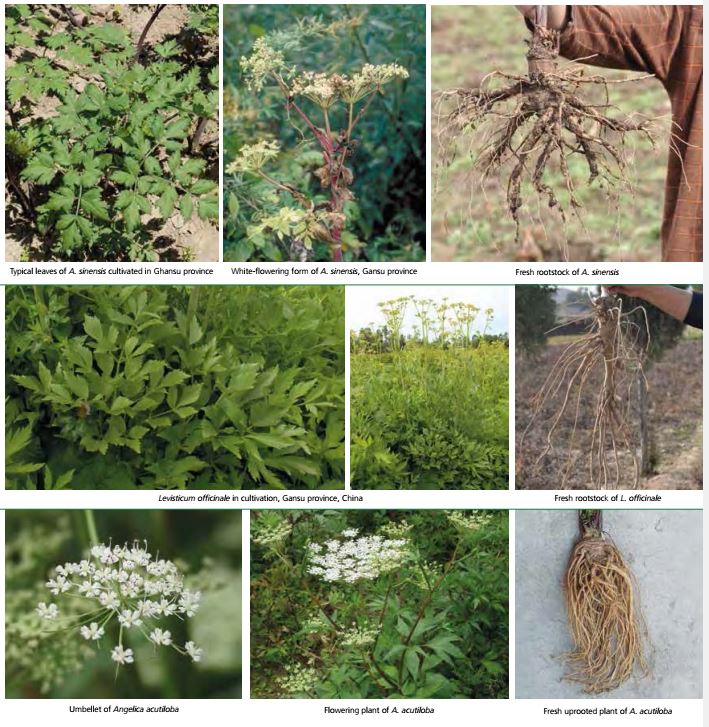
Main differences: Rootstock with main root-body smaller; lateral roots stouter and longer. Stems several; foliage and stems yellowish-green throughout.
主要區別:根莖主根體較小;側根粗壯且較長。莖數個;整個葉子和莖呈黃綠色。
Leaves with pinnae rhombic-ovate, widest at or above middle and much larger (4–11 cm long; 2–7 cm wide), margins with a few large teeth.
葉羽片菱形卵形,中部或以上最寬,較大(長4-11公分;寬2-7公分),邊緣有些大齒。
Inflorescence with bracts many (7–11) of unequal length and reflexed; rays 12–20; bracteoles 8–11; petals yellowish-green to yellow.
花序具許多(7-11)不等長且反折的苞片;射線 12-20;小苞片 8-11;花瓣黃綠色到黃色。
Fruit longer (5–7 cm) with lateral ribs thick-winged. 果實較長(5-7公分),側稜厚翅。
SUBSTITUTION COMMENT 替代藥材評論
Owing to its ease of cultivation and higher yields, L. officinale was extensively cultivated in China in the 1950s as a government approved substitute of ‘Dang Gui’ when the latter was in short supply.
由於其易於栽培且產量較高,當歸供應短缺時,藥用植物於 20 世紀 50 年代在中國廣泛種植,作為政府批准的「當歸」替代品。
‘Dang Gui’ production had recovered by the 1980s such that L. officinale as a substitute was banned in 1984 (Zhao & Xiao, 2009–10);
「當歸」的生產在 20 世紀 80 年代有所恢復,以至於 1984 年禁止使用鐵皮藥代用品(Zhao & Xiao,2009-10);
it continues to be widely grown in mainland China today for medicated teas (rootstocks) and as a vegetable (leaves and shoots).
如今,它仍然在中國大陸廣泛種植,用作藥茶(砧木)和蔬菜(葉和芽)。
CONSERVATION STATUS
China: not native. 中國:不是本土的。
Global: Not Evaluated (IUCN Red List, accessed 22/8/2016).全球:未評估(IUCN 紅色名錄,2016 年 8 月 22 日瀏覽)。
UNOFFICIAL SUBSTITUTE 非官方替代 2
Angelica acutiloba 當歸 (Siebold & Zucc.) Kitag.
synonym 同義詞: Ligusticum acutilobum Siebold & Zucc.
PLANT DESCRIPTION 植物描述
Easily distinguished from the Pharmacopoeia species. 容易與藥典品種區別。
Main differences主要區別:
rootstock crown many-stemmed with pliable lateral roots more numerous creating a larger and more densely interwoven root mass. Stems several.
根莖冠有許多莖,具有更多的柔韌側根,形成更大且更密集地交織的根群。莖數個。
Leaves 1–2 pinnate with leaflets usually much longer (2–9 cm long, 1–3 cm wide) and tips long-pointed, hairless, margins closely toothed, teeth sharply triangular. 葉 1-2 羽狀複葉,小葉通常較長(長 2-9 厘米,寬 1-3 厘米),尖端長尖,無毛,邊緣密齒,齒銳三角形。
Inflorescence with bracteoles 5–8 (linear and longer [5–15 mm]); petals white. 花序有小苞片 5-8 個(線形且較長 [5-15 mm]);花瓣白色。
Fruit narrower (4–5 mm long; 1–1.5 mm diam.) with narrower (4-5 mm long; 1-1.5 mm diam.) with narrowly winged lateral ribs. 果實較窄(4-5毫米長;1-1.5毫米直徑),較窄(4-5毫米長;1-1.5毫米直徑),具窄翅側稜。
SUBSTITUTION COMMENT.
With clinical properties similar to those of the Pharmacopoeia species (Zhao & Xiao, 2009–10), roots of A. acutiloba are used as a local ‘Dang Gui’ substitute in Jilin province (NE China) and where long cultivated for this purpose. In Japan and Korea its roots are the official source of ‘Riben Dang Gui’ (Japanese Angelica Root) and ‘Dang Gui’ in their respective Pharmacopoeias (JP16th; KP, 2007). The occurrence of this species as a substitute in Western markets is unlikely. CONSERVATION STATUS China: not native (cultivated only.) Global: Not Evaluated (IUCN Red List, accessed 22/8/2016).
Leon, Christine; Yu-Lin, Lin. Chinese Medicinal Plants, Herbal Drugs and Substitutes: An Identification Guide (English Edition) (p. 96). Royal Botanic Gardens, Kew. Kindle 版本.
TCM PROPERTIES AND USE
properties: ‘sweet, pungent and warm’
channels: ‘Heart, Liver and Spleen’
actions: ‘tonifies Blood, invigorates Blood, relieves pain, moistens the intestines’
indications: menstrual, menopause, pregnancy, postpartum disorders; traumatic injury, sores; constipation; coughs
Reference:
Leon, Christine; Yu-Lin, Lin. Chinese Medicinal Plants, Herbal Drugs and Substitutes: An Identification Guide (English Edition) (p. 96). Royal Botanic Gardens, Kew. Kindle 版本.
 Jade Health Acupuncture