Traditional Chinese medicine believes that there are many causes of headaches, including wind, heat, liver-yang, phlegm-dampness, deficiency syndrome, etc., especially deficiency syndrome caused by insufficient kidney qi. The disease is located in the head and is related to the three Yang meridians of the hands and feet, as well as the Jueyin Liver and Du meridians of the feet. The basic pathogenesis is imbalance of qi and blood, obstruction of meridians or lack of nourishment of brain orifices.
中醫認為頭痛的原因有很多,包括風、熱、肝陽、痰濕、虛證等,尤其是腎氣不足所造成的虛證。本病病位在頭,與手、足三陽經及足厥陰肝經、督脈相關。基本病機是氣血失和、經絡不通或腦竅失養。
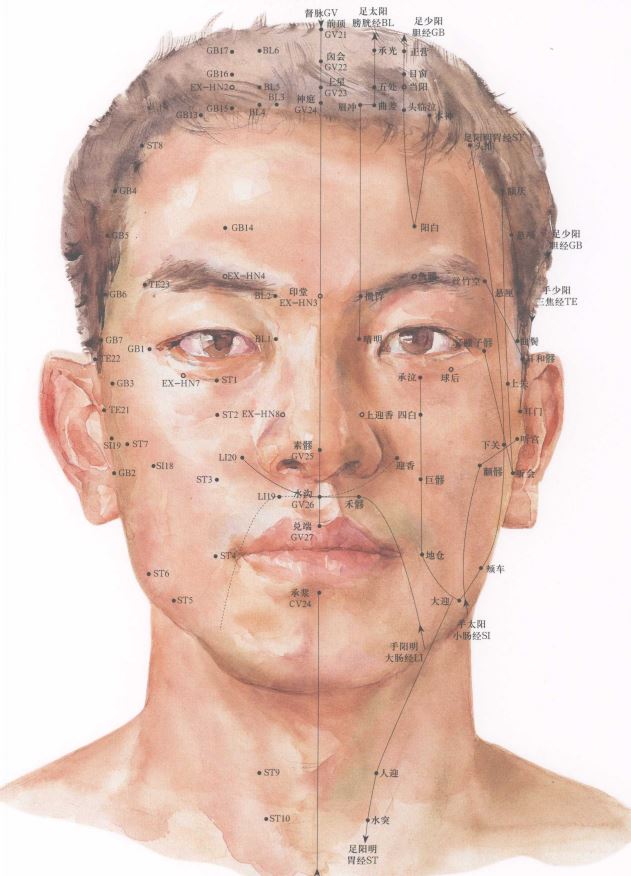
Skin and acupoints on the head, face, and neck (anterior aspect) 頭部頸部的皮膚與腧穴(前面)

Muscles and Acupoints on the Head, Face, and Neck (anterior aspect) 頭面頸部的肌肉與腧穴(前面)
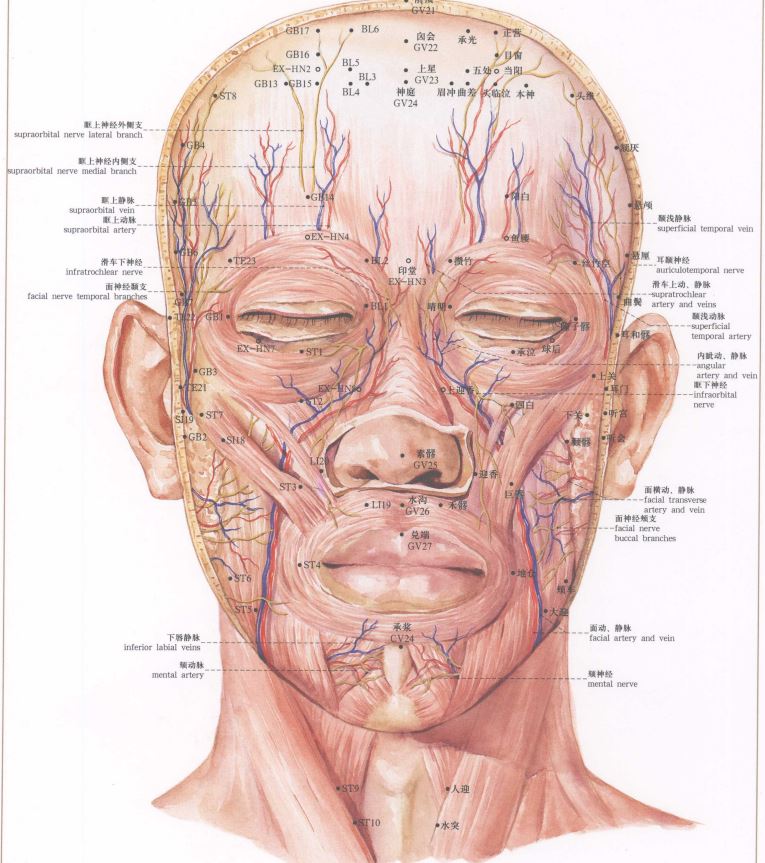
Blood vessels, Nerves and Acupoints on the Head. (anterior aspect) 頭面頸部的血管,神經與腧穴(前面)
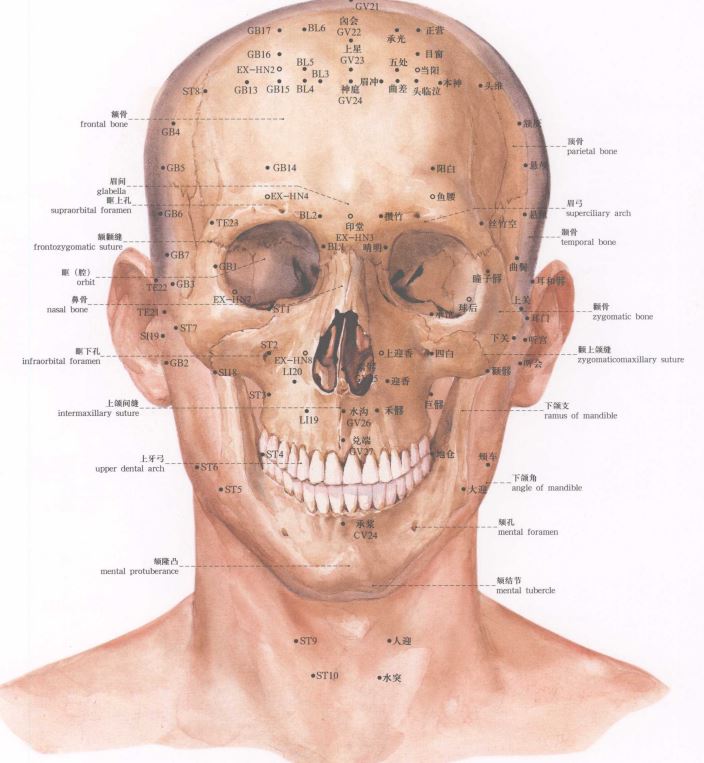
Skeletons and Acupoints on the Head, Face and Neck (Anterior Aspect) 頭面頸部的骨骼與腧穴 (前面)
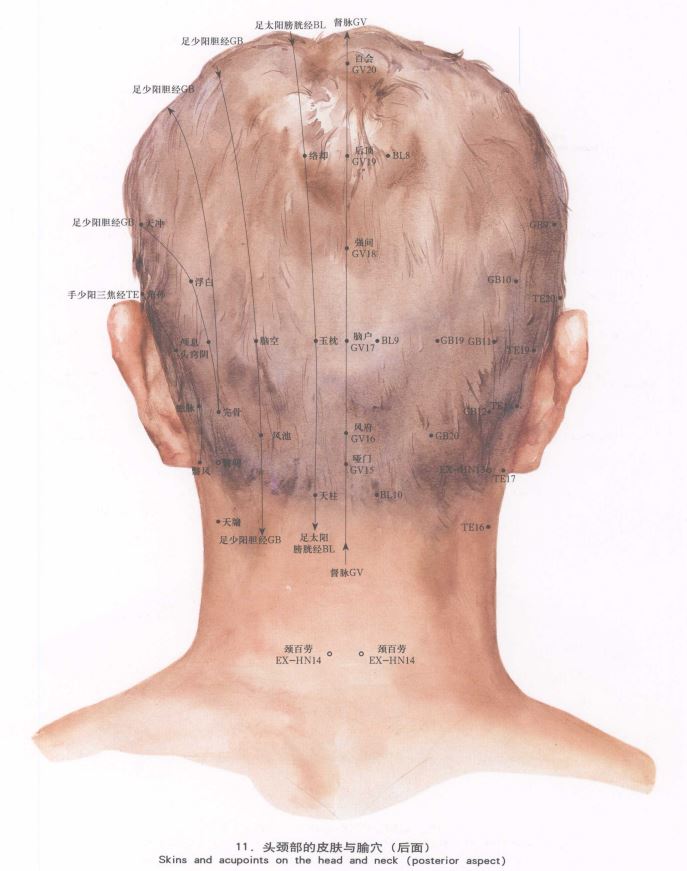
Skins and Acupoints on the Head and Neck (Posterior aspect) 頭頸部的皮膚與腧穴(後面)

Muscles and Acupoints on the Head and Neck (Posterior Aspect) 頭頸部的肌肉與腧穴(後面)
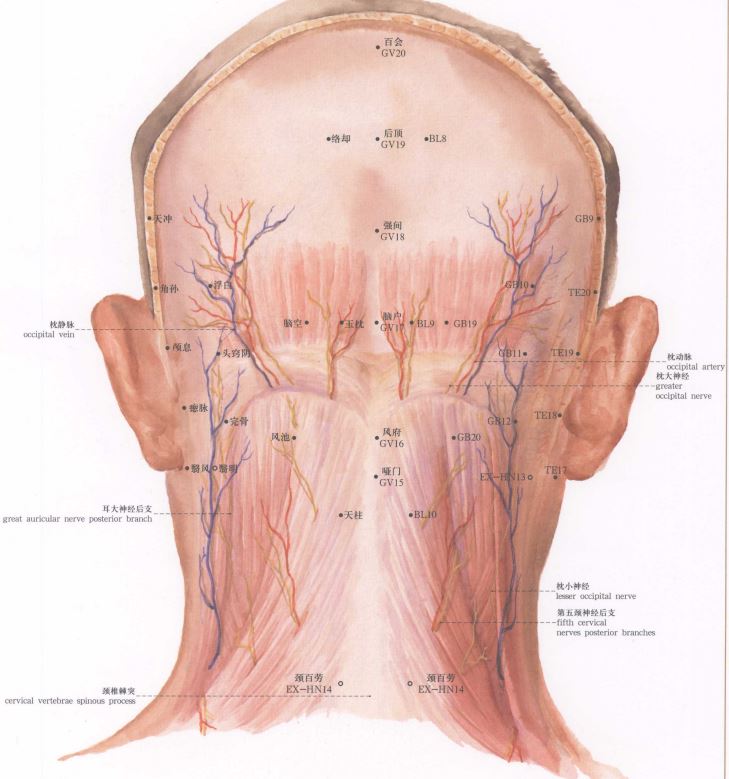
Blood Vessels, Nerves and Acupoints on the Head and Neck (Posterior Aspect) 頭頸部的血管、神經與腧穴(後面)
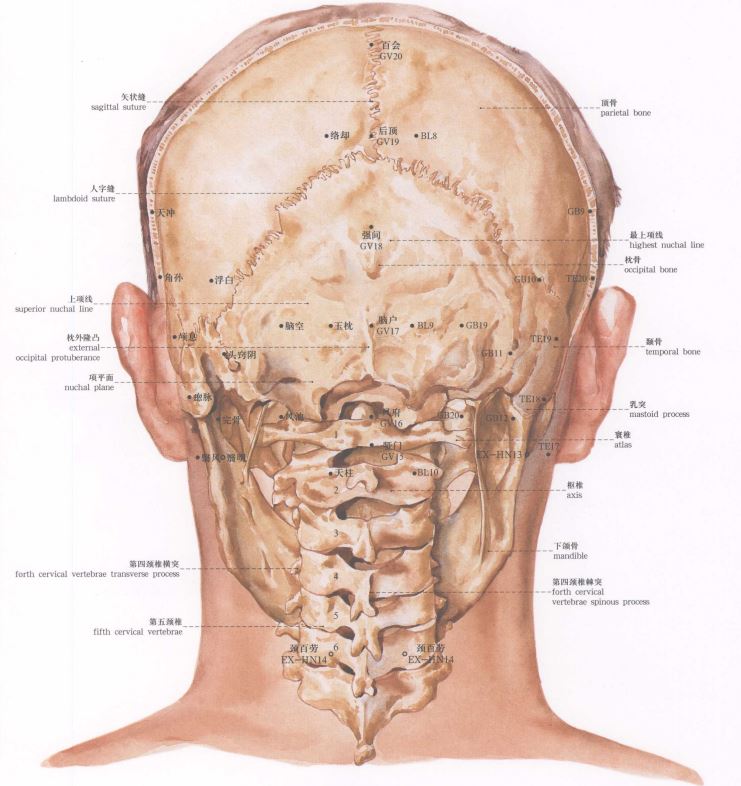
Skeletons and Acupoints on the Head and Neck (posterior aspect) 頭頸部的骨骼與腧穴(後面)
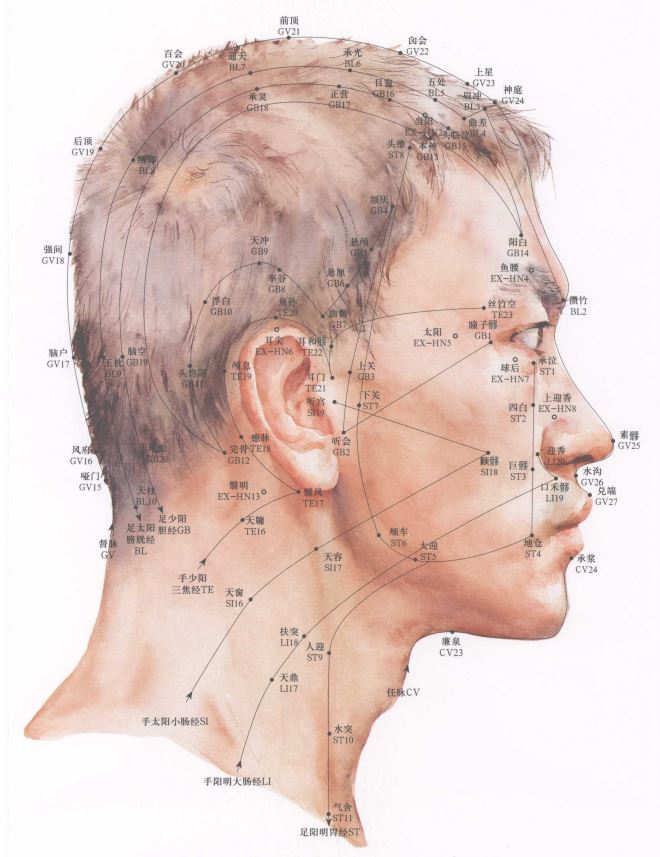
Skins and Acupoints on the Head, Face and Neck (Lateral Aspect) 頭面頸部的皮膚與腧穴(側面)

Muscles and Acupoints on the Head and Neck (Lateral Aspect) 頭頸部的肌肉與腧穴(側面)
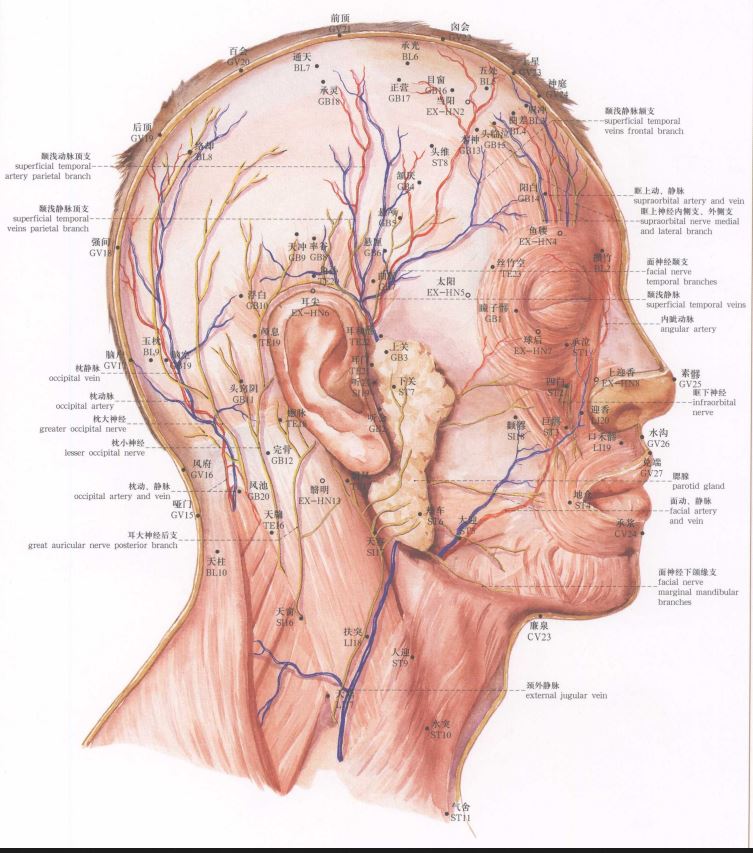
Blood Vessels, Nerves and Acupoints on the Head and Neck (Lateral Aspect) 頭頸部的血管、神經與腧穴(側面)
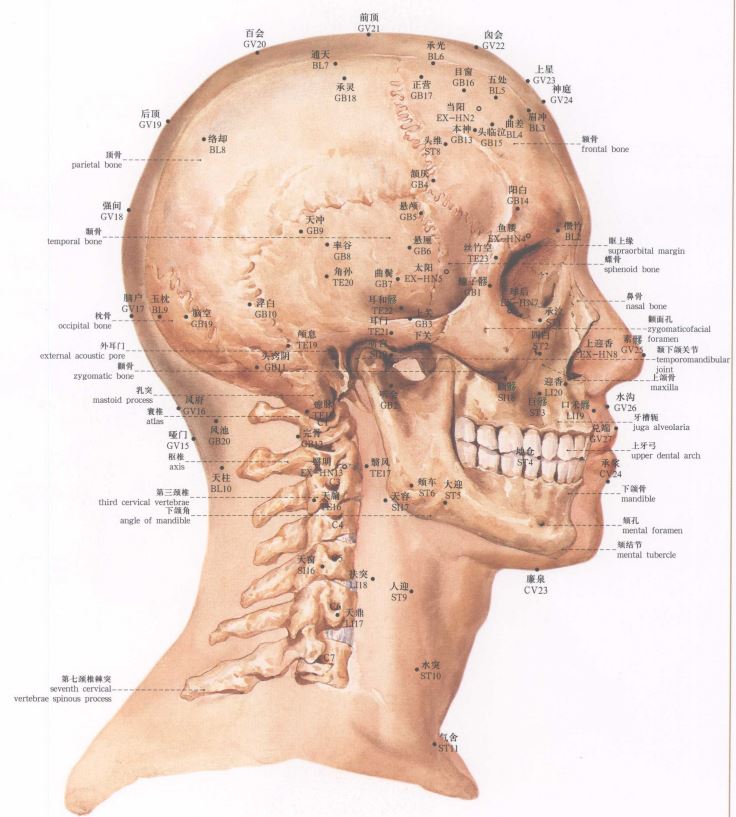
Skeletons and Acupoints on the Head and Neck (Lateral Aspect) 頭頸部的骨骼與腧穴(側面)

Head Acupoints on the Conception Vessel and Governor Vessel 任脈、督脈的頭部經穴圖
Western medicine believes that headaches are divided into two categories: primary and secondary. Primary headaches include migraines, tension headaches, cluster headaches, etc., also known as functional headaches; secondary headaches are caused by other diseases, such as increased intracranial pressure caused by infection, hypertension or intracranial tumors; headaches caused by head trauma, etc., also known as symptomatic headaches.
西醫認為,頭痛分為原發性和繼發性兩大類,原發性頭痛包括偏頭痛、緊張性頭痛和叢集性頭痛等,又稱功能性頭痛;繼發性頭痛是由於其他疾病所引起,如感染、高血壓病或顱內腫瘤導致的顱內壓升高;頭部外傷等所致的頭痛,又稱症狀性頭痛。
【Diagnosis 辨證】
Main symptoms: Head pain.
- Differentiation of Meridians: In clinical practice, syndrome differentiation and meridian distribution are often performed according to the location of the headache as follows:
- Yangming headache: The pain is mainly located on the forehead, brow bone, and root of the nose.
- Shaoyang headache: The pain is located on the side of the head, mostly on one side.
- Taiyang headache: The pain is located in the back of the occiput, or connected to the neck.
- Jueyin headache: The pain site is at the top, or connected to the eye system.
- Distinguish between external and internal injuries:
- (1)Exogenous headache: The onset is more acute, the headache extends to the neck and back, the pain is endless, and the external symptoms are obvious, it is an exogenous headache.
- Also seen are aversion to wind, fear of cold, lack of thirst, thin and white tongue coating, floating and tight pulse, indicating headache due to wind-cold;
- Headache with swelling, fever, thirst and desire to drink, yellow urine, yellow coating, and floating pulse are wind-heat headaches;
- Headache that feels like a wrap, heavy limbs, white and greasy coating, and moist pulse are symptoms of rheumatic headache.
- (2)Headaches due to internal injuries have a slow onset, are often accompanied by dizziness, and are continuous pain that sometimes stops. Headaches caused by internal injuries occur or become aggravated by exertion or emotional stimulation. This is an internal injury headache.
- Also seen are head swelling and pain, dizziness, upset and irritability, red face, bitter mouth, red tongue, yellow coating, stringy and rapid pulse, which are signs of hyperactivity of liver yang;
- Headache combined with dizziness, tinnitus, soreness and weakness in the waist and knees, mental fatigue, nocturnal emission, red tongue, less coating, thin and weak pulse, are due to insufficient kidney essence;
- Head pain combined with dizziness, mental fatigue, dull complexion, aggravated by exertion, pale tongue, thin and weak pulse, are signs of Qi and blood deficiency;
- Headache, dizziness, abdominal distention, vomiting and phlegm, white and greasy coating, and slippery pulse are caused by turbid phlegm;
- If the headache lingers for a long time, or there is a history of head trauma, the pain is fixed and unmovable, the pain is like a spiny, the tongue is dark, and the pulse is thin and astringent, which is caused by blood stasis blocking the brain collaterals.
- (1)Exogenous headache: The onset is more acute, the headache extends to the neck and back, the pain is endless, and the external symptoms are obvious, it is an exogenous headache.
主症: 頭部疼痛。
- 辨經絡: 臨床常依頭痛的部位進行辨證歸經如下:
(1)陽明頭痛: 疼痛部位以前額、眉棱骨、鼻根部為主。
(2)少陽頭痛: 疼痛部位在側頭部,多見於單側。
(3)太陽頭痛: 疼痛部位在後枕部,或下連於項部。
(4)厥陰頭痛: 疼痛部位在頂端,或連於目系。
- 辨外感內傷
- (1)外感頭痛: 發病較急,頭痛連及項背,痛無止盡,外感表證明顯,為外感頭痛。
- 兼見惡風畏寒,口不渴,苔薄白,脈浮緊,為風寒頭痛;
- 頭痛而脹,發熱,口渴欲飲,小便黃,苔黃,脈浮數,為風熱頭痛;
- 頭痛如裹,肢體困重,苔白膩,脈濡,為風濕頭痛。
- (2)內傷頭痛頭痛發病較緩,多伴隨頭暈,痛勢綿綿,時止時休,遇勞或情志刺激而發作、加重,為內傷頭痛。
- 兼見頭脹痛,目眩,心煩易怒,面赤口苦,舌紅,苔黃,脈弦數,為肝陽上亢;
- 頭痛兼頭暈耳鳴,腰膝酸軟,神疲乏力,遺精,舌紅,苔少,脈細無力,為腎精不足;
- 頭空痛兼頭暈,神疲無力,面色不華,勞則加重,舌淡,脈細弱,為氣血虧虛;
- 頭痛昏蒙,脘腹痞滿,嘔吐痰涎,苔白膩,脈滑,為痰濁上擾;
- 頭痛遷延日久,或頭部有外傷史,痛處固定不移,痛如錐刺,舌暗,脈細澀,為瘀阻腦絡。
- (1)外感頭痛: 發病較急,頭痛連及項背,痛無止盡,外感表證明顯,為外感頭痛。
Treatments Plan 1:
Principal points主穴:
GB-20(Fengchi風池), M-HN-9(Taiyang太陽), DU-20(Baihui百會), LIV-3(Taichong太衝), GB-8(Shuaigu率谷), TB-3 (Zhongzhu中渚)
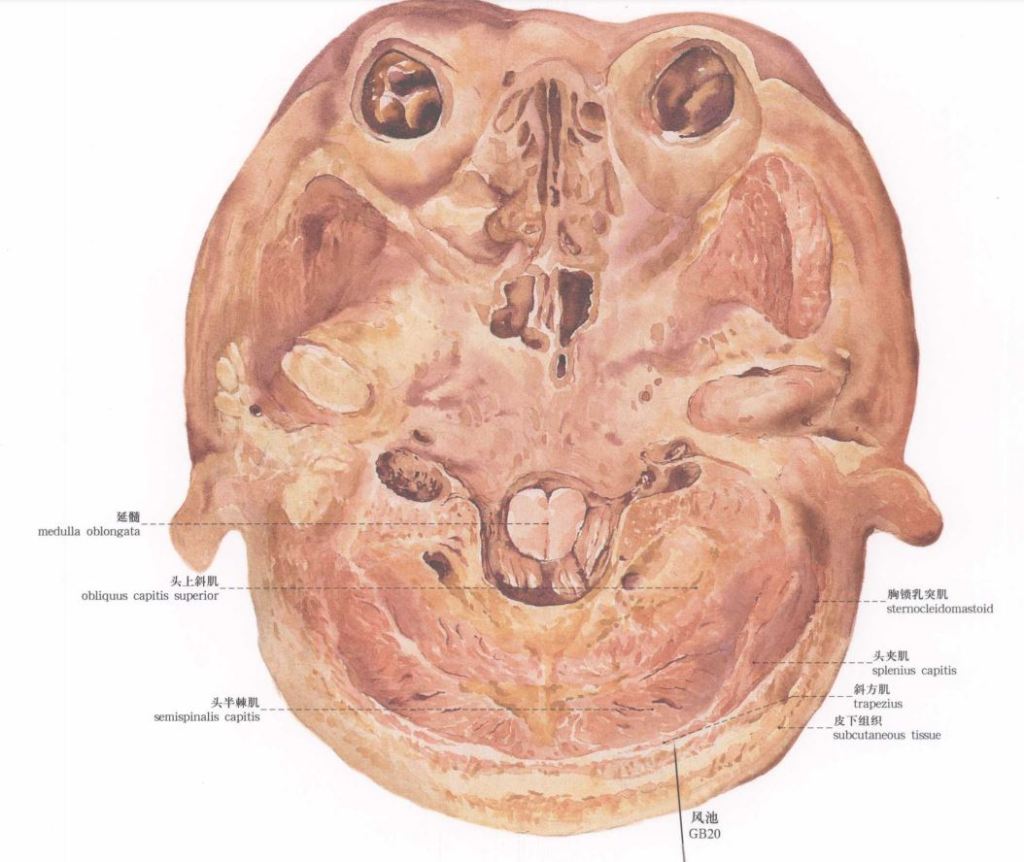
Transverse Section of Fengchi (GB20) 風池橫斷面(GB20)
- Behind the nape, it is level with Fengfu point, in the depression between the sternocleidomastoid muscle and the upper end of the trapezius muscle.項後,與風府穴相平,當胸鎖乳突肌與斜方肌上端之間的凹陷處。
- The hierarchical structure of the acupoints is as follows: skin → subcutaneous tissue → between the trapezius and sternocleidomastoid muscles → splenius capitis → semispinalis capitis → between rectus capitis major and oblique capitis muscles. The superficial layer is covered with branches or tributaries of the lesser occipital nerve and occipital artery and vein. The deep layers include the suboccipital nerve and occipital artery.穴位層次結構依序為皮膚→皮下組織→斜方肌與胸鎖乳突肌之間→頭夾肌→頭半棘肌→頭後大直肌與頭上斜肌之間。淺層布有枕小神經和枕動、靜脈的分支或屬支。深層有枕下神經和枕動脈等分佈。
- Make an oblique insertion 0.5 to 0.8 units toward the angle of the mandible or the tip of the nose. Can be used for moxibustion.向下顎角或鼻尖方向斜刺0.5~0.8寸。可灸。
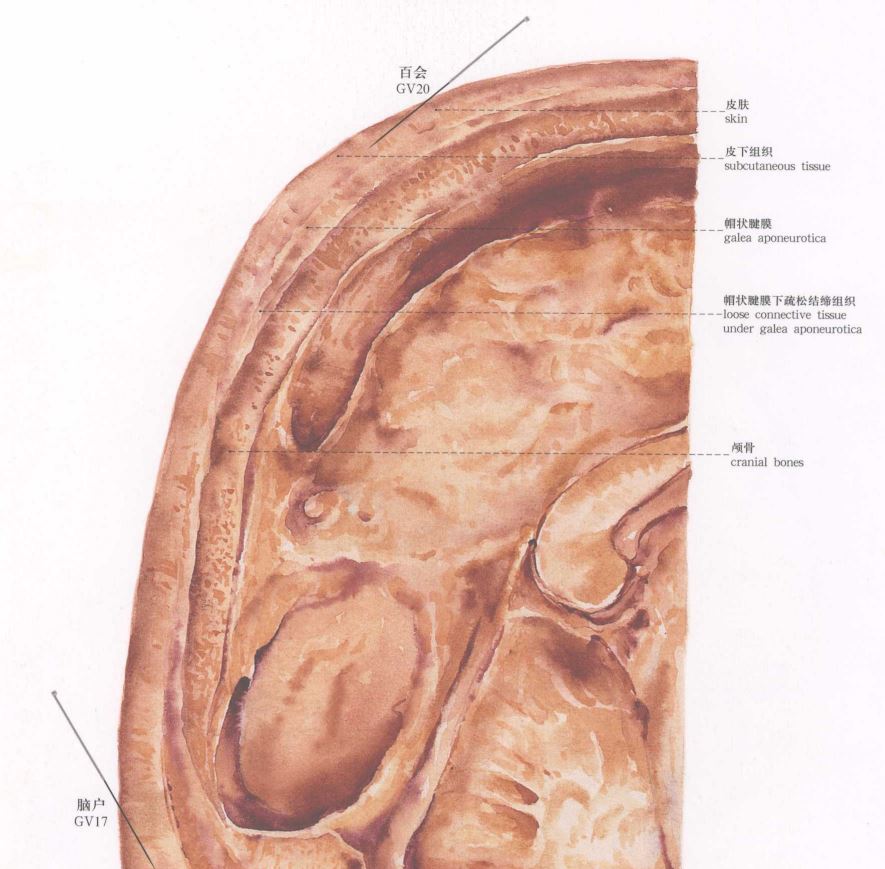
Baihui (GV20) 百會
- On the head, 7 inches straight above the middle of the back hairline, at the midpoint of the line connecting the tips of the two ears. 在頭部,當後髮際正中直上7寸,兩耳尖連線的中點處。
- The hierarchical structure of acupoints is Skin → subcutaneous tissue → galea aponeurosis → loose connective tissue under the galea aponeurosis. It is covered with branches of the greater occipital nerve, frontal nerve, left and right superficial temporal arteries, veins, and occipital arteries and veins anastomosis network. 穴位層次結構依序為皮膚→皮下組織→帽狀腱膜→帽狀腱膜下疏鬆結締組織。布有枕大神經、額神經的分支及左右顳淺動、靜脈及枕動、靜脈吻合網。
- Flat insertion 0.5~0.8 units. 平刺0.5~0.8寸。
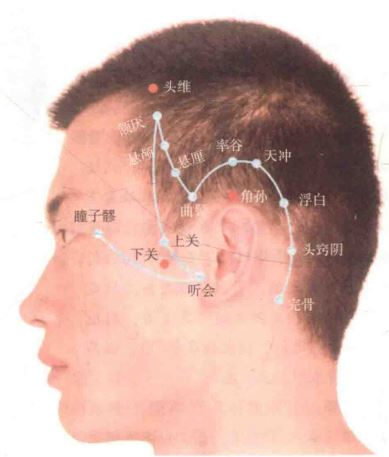
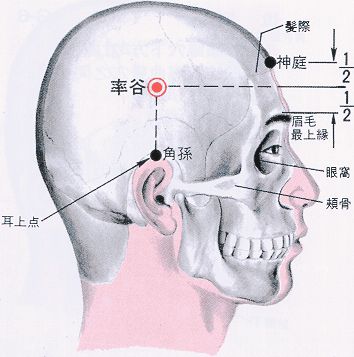
GB-8(Shuaigu, Leading to Valley)率谷:
The tip of the ear on the head: straight up to 1.5 units from the hairline
頭部耳尖:直上入髮際一寸五分處
Indications: Migraine headache, vertigo, eye diseases.
主治:偏頭痛、眩暈、眼疾。
Method: Transverse insertion, 1-2 units.
方法:橫向插入,1-2寸。
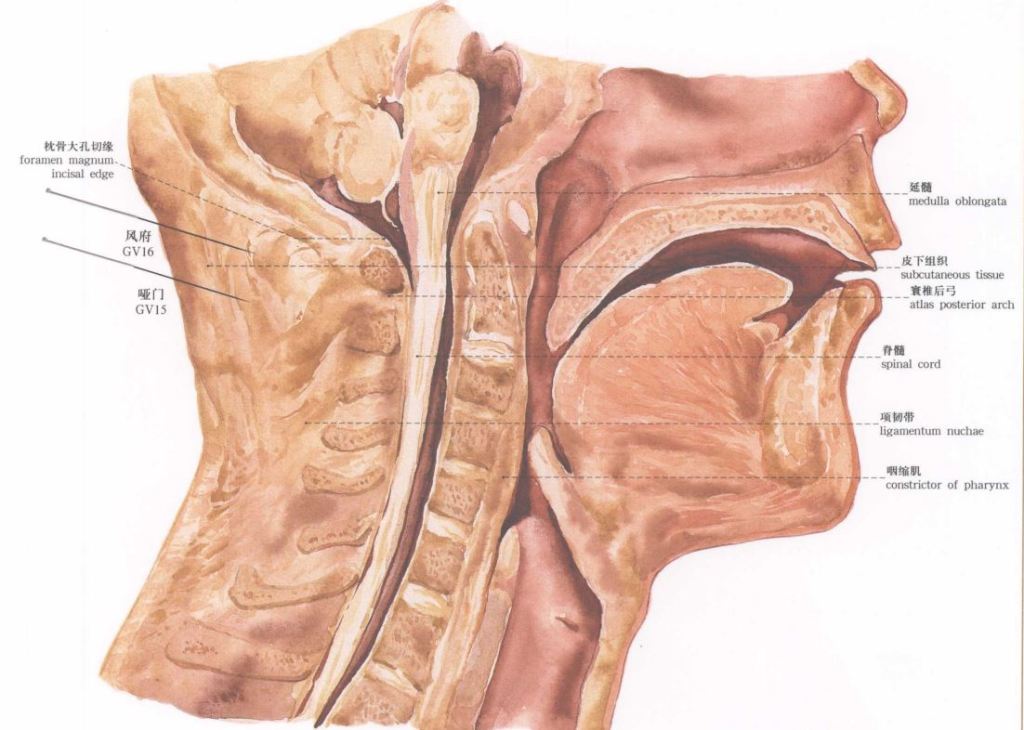
Sagittal Section of Fengfu (GV16) 風府橫斷面
- In the nape, 1 unit directly above the middle of the posterior hairline, directly below the external occipital protuberance, in the depression between the trapezius muscles on both sides.在項部,當後髮際正中直上1寸,枕外隆突直下,兩側斜方肌之間的凹陷處。
- The hierarchical structure of the acupoints is as follows: skin → subcutaneous tissue → between the left and right trapezius tendons → nuchal ligament (between the left and right semispinalis capitis muscles) → between the left and right rectus capitis major and minor muscles. The superficial layer is covered with branches of the greater occipital nerve and the third occipital nerve, as well as branches or tributaries of the occipital artery and vein. There are branches of the suboccipital nerve in the deep layer, and the medulla oblongata in the deeper layer.穴位層次結構依序為皮膚→皮下組織→左、右斜方肌腱之間→項韌帶(左、右頭半棘肌之間)→左、右頭後大、小直肌之 間。淺層布有枕大神經和第3枕神經的分支及枕動、靜脈的分支或屬支。深層有枕下神經的分支,再深層為延髓。
- Straight or diagonally downward insertion 0.5 to 1.0 units. Moxibustion is prohibited.直刺或向下斜刺0.5~1.0寸。禁灸。
Supplementary points配穴:
LI-4 (Hegu合谷), LI-11 (Quchi曲池), LU-7 (Lieque列缺), TB-5 (Waiguan外關), GV-16 (Fengfu風府), LIV-2(Xingjian行間), GB-40 (Qiuxu丘墟), KI-3 (Taixi太谿), SI-3 (Houxi后谿), BL-2(Zanzhu攒竹), BL-10 (Tianzhu天柱), BL-65 (Shugu束谷), GB-14 (Yangbai陽白), GB-41 (Zulinqi足臨泣), ST-8 (Touwei頭維), ST-36(Zusanli足三里), ST-40 (Fenglong豐隆), ST-43(Xiangu陷谷), RN-6 (Qihai氣海), RN-4 (Guanyuan關元), RN-12 (Zhongwan中脘), M-HN-3 (Yintang印堂)
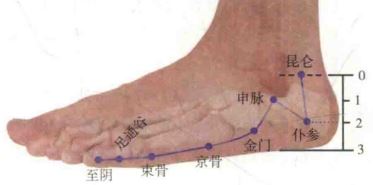
BL-65 (Shugu, Restraining Bone)束谷
In depression posterior and lateral to the head of the 5th metatarsal bone.
在第五蹠骨骨後外側凹陷處。
Indications: Headache and stiff neck, malaria, pannus, seizures, mental illness.
主治:頭痛和頸部僵硬、瘧疾、血管翳、癲癇發作、精神疾病。
Method: Straight insertion, 0.3-0.5 unit.
方式:直刺,0.3-0.5寸
Treatment Method 治療方法:
First, needle GB-20 (Fengchi) until the needle sensation extends to the frontotemporal region.
首先針風池直到針感延伸至額顳區。
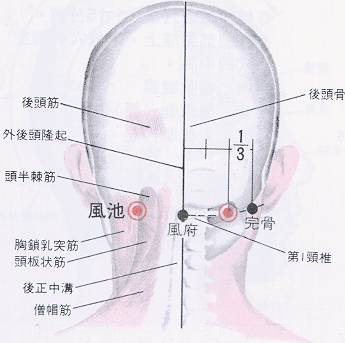
GB-20 (Fengchi, Pool of Wind) 風池
GB-20 (Fengchi) is located in the nape, under the occipital bone, in the depression between the upper outer edge of the trapezius muscle and the upper rear edge of the sternocleidomastoid muscle.
項部枕骨下,斜方肌上部外緣與胸鎖乳突肌上端後緣之間凹陷處。
Indications: Common cold, vertigo, headache, stiff neck, eye diseases, rhinitis, tinnitus, deafness, hypertension, seizures, hemiplegia, brain diseases.
Traditional indications: Sinusitis, eyes red and sore, deafness, tinnitus, lateral and midline headaches, insomnia, common cold, tidal fevers, swellings or tumors on the neck.
主治:感冒、眩暈、頭痛、落枕、眼疾、鼻炎、耳鳴、耳聾、高血壓、癲癇、偏癱、腦部疾病。
傳統適應症:鼻竇炎、眼睛紅腫酸痛、耳聾、耳鳴、側中線頭痛、失眠、感冒、潮熱、頸部腫脹或腫瘤。
Needling method
( 1) Straight insertion, level with the ear lobe, pointed slighty downward, 1-1.5 units. Sensation: local distension and soreness, possibly extending to the top of the head, the temple, forehead or eyes.
(2) Slanted insertion, joined to opposite GB-20 (Fengchi), 2-3 units. Sensation: local distension and soreness, sometimes extending throughout the back of the neck.
針刺法
(1) 直插入,與耳垂齊平,尖端稍向下,1-1.5寸。感覺:局部脹痛,可能延伸至頭頂、太陽穴、額頭或眼睛。
(2)斜插,透刺對側風池,2-3寸。感覺:局部腫脹和酸痛,有時會延伸到整個頸後。
CAUTION: Caution must be exercised to avoid inserting the needle too deeply, puncturing the medulla oblongata. 注意:必須小心,避免進針過深,刺穿延髓
For headache at the vertex, add DU-20(Baihui) and LIV-3(Taichong). 頭頂痛加百會、太衝。
For temporal headache, add M-HN-9(Taiyang) joined to GB-8(Shuaigu) and TB-3 (Zhongzhu). 顳部頭痛,加太陽透刺至率谷,並加上中渚。
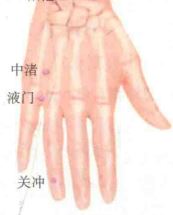
TB-3 (Zhongzhu, Middle Island) 中渚
located between the 4th and 5th metacarpal bones on the back of the hand, in the depression behind the metacarpophalangeal joint.位於手背第4~5掌骨間,掌指關節後方凹陷處。
Indications: Deaf-mutism, tinnitus, deafness, headache, pain in the shoulder and back, intercostal neuralgia
Traditional indications: Pain in shoulder, back, elbow and arm, inability to bend fingers, headache, tinnitus, blurred vision.
主治:聾啞、耳鳴、耳聾、頭痛、肩背疼痛、肋間神經痛
傳統適應症:肩膀、背部、手肘、手臂疼痛,手指不能彎曲,頭痛,耳鳴,視力模糊。
Needling method: Straight insertion, or slanted toward the wrist, 1-1.5 units. Sensation: local distension and soreness, sometimes extending to the fingertips or forearm, or an electric, numb sensation reaching the fingertips.
進針方法:直刺,或斜向腕部,1-1.5寸。感覺:局部脹痛,有時延伸至指尖或前臂,或有電擊麻木感到達指尖。
Remarks: Transporting point of the Triple Burner channel.三焦經的輸穴。
For frontal headache, add , GB-14 (Yangbai) joined to BL-2(Zanzhu) andLI-4 (Hegu). 額頭頭痛,加陽白透刺攢竹和合谷。
For occipital headache, add BL-10 (Tianzhu) and SI-3 (Houxi). 對於枕部頭痛,加天柱和後溪。
Needle with small amplitude until the Qi sensation is obtained. Then needle vigorously for 5-15 minutes. 進針幅度要小,直至有氣感。然後激烈行針5-15分鐘。
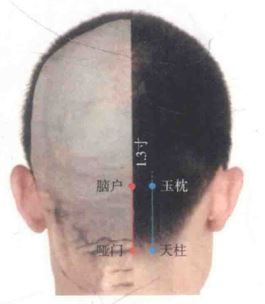
BL-10 (Tianzhu, Heaven’s Pillar) 天柱
BL-10 (Tianzhu) is located at the back of the neck. Horizontal to the superior edge of the spinous process of the second cervical vertebra, in the depression at the outer edge of the trapezius muscle. Or find the hairline behind the nape and the depression on the outer edge of the trapezius muscle.天柱位於頸後區。橫平第2頸椎棘突上際,斜方肌外緣凹陷中。或找項後髮際,斜方肌外緣凹陷處。
Indications: Occipital headache, stiffness and soreness in the back of the neck, pharyngitis, hysteria, neurasthenia.
Traditional indications: Heavy, dizzy, and painful head, nasal congestion and swelling of the larynx, eye diseases, seizures, infantile convulsions.
主治:枕部頭痛、頸後僵硬酸痛、咽炎、癔病、神經衰弱。
傳統主治:頭重、頭暈、痛、鼻塞、喉腫、眼疾、驚風、小兒驚風。
Needling method: Straight insertion, 0.5-1 unit. Sensation: local distension and soreness, sometimes extending to the top of the head. CAUTION: Do not point needle upward where it might puncture the medulla oblongata.
進針方式:直刺,0.5-1寸。感覺:局部脹痛,有時會延伸至頭頂。注意:請勿將針頭向上,否則可能會刺穿延髓。
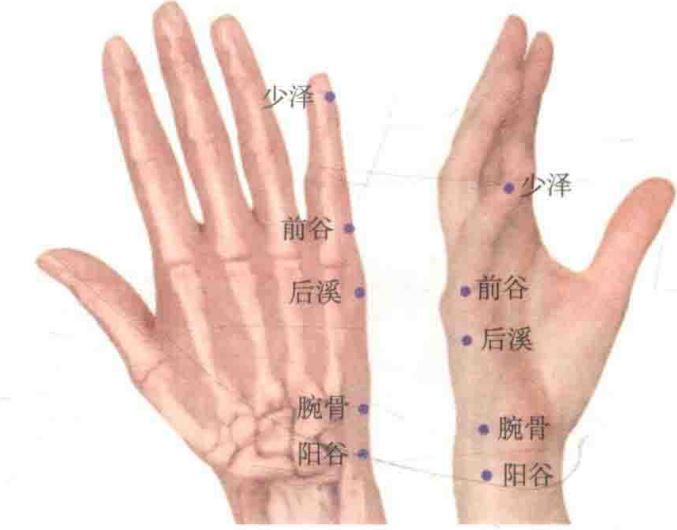
SI-3 (Houxi, Back Creek)後溪
When the hand is clenched in a fist, this point can be found behind and lateral to the head of the 5th metacarpus, at the top of the transverse crease formed by the clenched fist.
手握拳時,第五掌骨頭後側方,握拳形成的橫紋上方。
Indications: Malaria, seizures, psychosis, hysteria, intercostal neuralgia, night sweats, stiff neck, deaf-mutism, low back pain.
Traditional indications: Eyes red and painful, membrane on the eye, tinnitus, deafness, jaundice, madness, tidal fevers, finger spasm.
主治:瘧疾、驚厥、精神病、癔病、肋間神經痛、盜汗、落枕、聾啞、腰痛。
傳統主治:目赤痛、目附膜、耳鳴、耳聾、黃疸、瘋病、潮熱、手指痙攣。
Needling method: Straight insertion, with fist clenched, along the metacarpus in a medial direction, 0.5-1 unit. For finger spasm, join to LI-4 (Hegu), 1.5-2 units.
針法:直刺,握拳,沿掌骨內側方向刺0.5~1寸。
對於手指痙攣,透刺合谷,1.5-2寸。
Sensation: local distension and soreness possibly extending throughout hand.感覺:局部腫脹和酸痛可能延伸至整個手部。
Remarks: Transporting point of the Small Intestine channel. Meeting point of the Governing channel on the Small Intestine channel. 小腸經輸穴。八脈交會穴通督脈。
Some of the points above, among them M-HN-9(Taiyang), DU-20(Baihui), TB-3 (Zhongzhu) and LIV-3(Taichong) may be used regardless of the
location of the headache.上述一些穴位,其中太陽、百會、中渚和太衝,無論
頭痛的位置,皆可使用。

M-HN-9(Taiyang, Sun) 太陽
located at the temple, approximately 1 unit posterior to the midpoint between the outer canthus of the eye and the tip of the eyebrow. 在顳部,當眉梢與目外眥之間,向後約一橫指的凹陷處。
Indications: Headache, migraine headache, common cold, facial paralysis, trigeminal neuralgia, eye diseases.
Traditional indications: Lateral and midline headaches, sore, red and swollen eyes, sty, membrane over eye.
主治:頭痛、偏頭痛、感冒、顏面神經麻痺、三叉神經痛、眼科疾病。
傳統適應症:偏側與中線頭痛、眼睛酸痛、紅腫、麥粒腫、眼膜。
Needling method
(1) Straight insertion, 0.5-1 unit Sensation: local distension and soreness.
(2) Transverse insertion to treat migraine headache, point needle backward to join GB-8 (Shuaigu), 1-2 units. Sensation: distension and soreness extending throughout the temple.
(3) Transverse insertion, to treat facial paralysis, point needle downward to join with ST-6 (Jiache), 3 units. Sensation: distension and soreness, possibly extending as far as the tongue.
(4) The point can be pricked for a few drops of blood when treating either acute conjunctivitis or headache.
針刺法
(1)直刺,0.5-1寸 感覺:局部脹痛。
(2)橫刺治偏頭痛,透刺率骨,1-2寸。感覺:整個太陽穴有脹痛感。
(3)橫刺,治療面癱,針尖向下透刺頰車,3寸。感覺:脹痛,可能延伸至舌頭。
(4)治療急性結膜炎或頭痛時,可刺該穴數滴血。
If the headache is caused by Wind, add GV-16 (Fengfu), LU-7 (Lieque) and TB-5 (Waiguan). 如果頭痛是風引起的,加風府、列缺和外關。
Acute symptoms associated with Wind of an external origin include sudden onset, fever and chills, stuffy nose, aching body and possibly coughing. 與外風相關的急性症狀包括突然發作、發燒和發冷、鼻塞、身體酸痛,甚至可能咳嗽。
Chronic symptoms which accompany the prolonged presence of Wind in the body, include frequent headaches, shivering and sensitivity to wind, body fatigue. 風在體內長期存在所帶來的慢性症狀包括經常頭痛、發抖、對風敏感、身體疲勞。

GV-16 (Fengfu, Wind’s Dwelling)風府
Located 1 unit above the hairline behind the midline of the neck, directly below the external occipital protuberance, in the depression between the trapezius muscles on both sides.風府穴位於項部正中線後髮際上1寸,當枕外隆凸直下,兩側斜方肌之間凹陷處。
Indications: Stiff neck, numbness of the limbs, common cold, headache, stroke, mental illness.主治:頸項強直、四肢麻木、感冒、頭痛、中風、精神病。
Method: Straight insertion, 0.5-1 unit CAUTION: Avoid deep insertion.
方法:直刺,0.5-1 寸。 注意:避免深刺。
If the headache is due to Excessive Liver Yang, add KI-3 (Taixi), BL-23 (Shenshu), LIV-2(Xingjian). 若頭痛為肝陽上亢者,加太谿、腎俞、行間。
Symptoms associated with this condition include dizziness, insomnia, emotional fatigue, soreness in the lower back, spermatorrhea, palpitations, tinnitus, blurred vision, amnesia. If the headache arises from Deficient Kidney Qi, add RN-4 (Guanyuan, RN-6 (Qihai) and ST-36(Zusanli). Symptoms associated with this condition include fatigue and lowered voice. Moxibustion may also be applied at these points.與這種情況相關的症狀包括頭暈、失眠、情緒疲勞、腰部酸痛、遺精、心悸、耳鳴、視力模糊、健忘。如果頭痛是腎氣虛引起的,加關元、氣海和足三里。艾灸也可以應用於這些穴位。
If the headache is associated with Heat in the Stomach or Fire in the Liver and Gall Bladder, add GB-40 (Qiuxu), LIV-3(Taichong), ST-43(Xiangu), ST-8 (Touwei). Symptoms of these conditions include burning fever, severe headache, bloodshot eyes, pain in the ribs, thirst, constipation, vomiting or lumps in the upper abdomen and chest, etc.若頭痛屬胃熱或肝膽火者,加丘墟、太衝、陷谷、頭維。這些病症的症狀包括發燒、嚴重頭痛、眼睛充血、肋骨疼痛、口渴、便秘、嘔吐或上腹部和胸部有腫塊等。

GB-40 (Qiuxu)丘墟
GB-40 (Qiuxu) is in the hollow just below and slightly anterior to the lateral malleolus of the ankle.丘墟在踝部外踝稍前下方凹陷處。
If the headache is caused by Dampness and Phlegm, add RN-12 (Zhongwan) and ST-40 (Fenglong). Symptoms associated with this condition include fullness or lumps in the upper abdomen or chest, vomiting frothy fluids, vertigo, etc. If these symptoms are accompanied by Deficient Qi add ST-36(Zusanli), RN-4 (Guanyuan) and RN-6 (Qihai). Apply moxibustion at these points for Deficient Qi. 如果頭痛是濕痰引起的,加中脘和豐隆。與此症狀相關的症狀包括上腹部或胸部飽脹或腫塊、嘔吐泡沫液體、眩暈等。如果這些症狀伴隨氣虛,則加入足三里、關元和氣海。可以艾灸這些穴位治療氣虛。
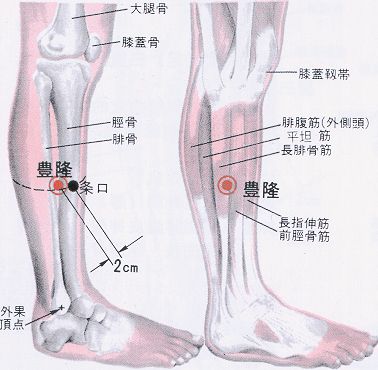
ST-40 (Fenglong)豐隆
ST-40 (Fenglong) is located at the midpoint of the line connecting the outer knee eye (calf nose) and the outer malleolus tip.豐隆位於外膝眼(犢鼻)與外踝尖連線的中點。
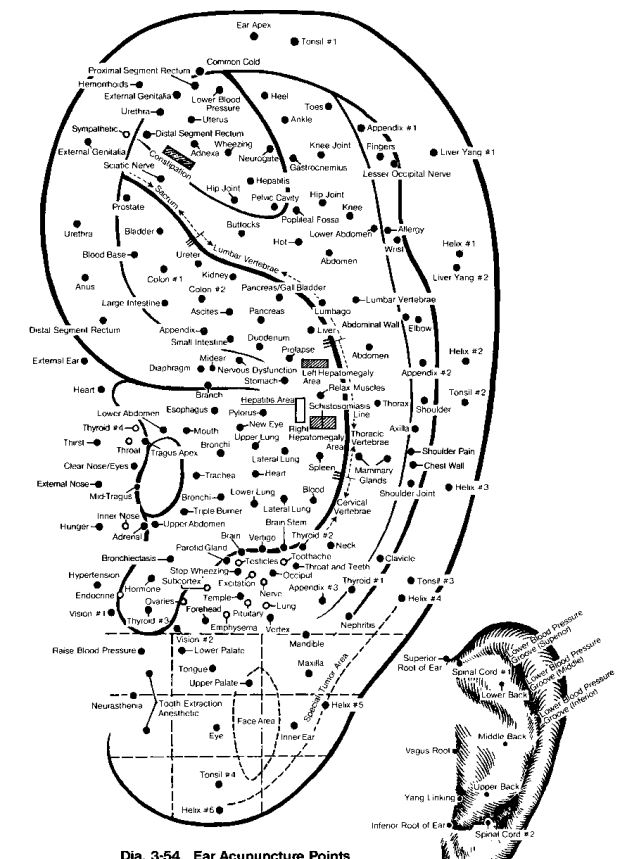
Ear acupuncture耳針療法:
Points: Subcortex, Forehead, Occiput, Kidneys, Pancreas/Gall Bladder and other points of tenderness on the ear. 穴位:皮質下、額頭、枕骨、腎臟、胰臟/膽囊和耳朵上的其他壓痛點
Method: After inserting the needles, manipulate intermittently. For persistent headache, use strong stimulation for about 5 minutes. Intradermal needles may also be embedded for periods of 1-7 days.
方法:進針後,間斷操作。持續性頭痛,可使用強烈刺激約5分鐘。皮內針也可埋置 1-7 天。
Cutaneous acupuncture and cupping皮針和拔罐:
Principal points: From the 1st lumbar to the 4th sacral vertebra. 主穴:第一腰椎至第四骶椎
Supplementary points: GB-20(Fengchi), M-HN-9(Taiyang), GB-14 (Yangbai).補充穴位:風池、太陽、陽白
Method: Tap along the vertebrae, then at the site of pain on the head, as well as the palms and finger tips. If the headache is severe, also tap supplementary points until there is slight bleeding, then apply cups.方法:沿著脊椎骨輕敲,再輕敲頭部疼痛處,以及手掌、指尖。若頭痛劇烈,也可輕敲補穴,直至輕微出血,再拔罐。
Injection therapy穴位注射:
Points: GB-20(Fengchi), BL-10 (Tianzhu), GB-14 (Yangbai), BL-2(Zanzhu).主穴:風池、天柱、陽白、攒竹。
Method: Inject, on the affected side, either Angelica sinesis ( danggui), vitamin B1 and B 12, a 10% glucose solution, or saline. Insert needle 0.3-0.5 inch, withdraw slightly, then inject the medicine. This will cause the sensation to extend outward from the point. Treat once every other day. PS. Injection therapy is not allowed in BC at the moment.方法:患側注射當歸、維生素B1、B 12、10%葡萄糖溶液或生理食鹽水。進針0.3-0.5寸,稍微退出,然後注射藥物。這將導致感覺從該穴位向外延伸。每隔一天治療一次。附註。目前 BC 省不允許穴位注射。
Head acupuncture頭針療法:
Points: For frontal headache, use the Facial area in the Sensory area on either the affected side, or both sides of the head. For occipital headache, use the Lower limb, head and trunk area in the Sensory area.
主穴:對於額頭頭痛,可使用患側或頭部兩側感覺區的臉部區域。對於枕部頭痛,使用感覺區的下肢、頭部和軀幹區域。
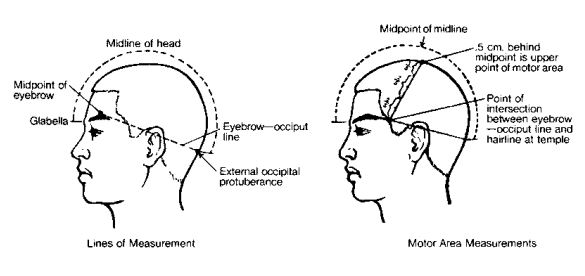
Motor Area運動區
Motor Area: A line starting from a point 0.5 cm posterior to midpoint of midline and stretching diagonally across the head to a point at the intersection of the zygomatic arch (superior margin) with the hairline at the temple.運動區:從中線中點後 0.5 公分處開始,沿對角線穿過頭部,到達顴弓(上緣)與顳部髮際線交點的線。
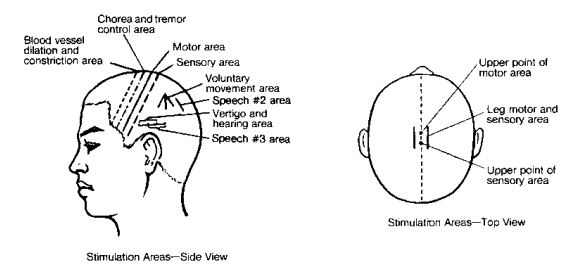
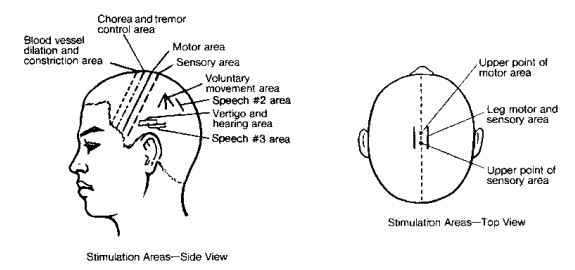
Sensory Area感覺區:
Sensory Area: A line parallel and 1.5 cm posterior to the Motor line. 感覺區:與運動線平行且位於運動線後 1.5 公分的線。
Facial area臉部區域:
Lower two fifths of Sensory area line. 感覺區域線的下五分之二。
Lower limb, head and trunk area下肢、頭部和軀幹區域:
Upper fifth of Sensory area line.感覺區線的上五分之一。
Hand acupuncture:
Points主穴:
- Forehead, Vertex, and supplement with M-HN-3 (Yintang). 額頭、頂點,輔以印堂。
- Side of Head, Occiput, and supplement with LI-11 (Quchi) or M-HN-9(Taiyang).頭側、枕骨,輔以曲池或太陽
Method: Select one of the two prescriptions above according to the location of the headache. Use strong stimulation, retaining the needles for 15-20 minutes with intermittent needle manipulation. 方法:根據頭痛部位,選擇上述二方之一。採用強烈刺激,留針15-20分鐘,間斷行針。
Seven to ten treatments constitute one course. 七至十次為一個療程。
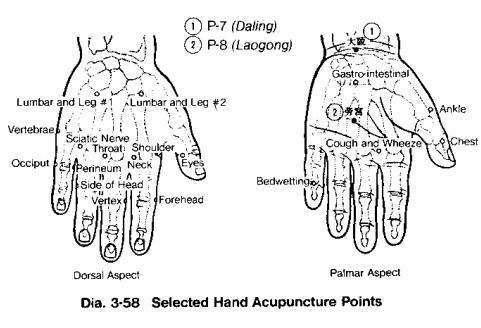
Forehead前額:
At the border of the light and dark skin on the radial side of index finger and the first interphalangeal joint.食指橈側與第一指間關節明、暗皮膚交界處。
Vertex頂點:
At the border of the light and dark flesh on medial side of middle finger at the first interphalangeal joint. 中指內側第一指間關節處明、暗肉交界處。
Side of Head頭部側面:
At the border of the light and dark flesh on ulnar side of fourth finger at the first interphalangeal joint. 無名指尺側第一指間關節明、暗肉交界處。
Occiput枕骨:
At the border of the light and dark skin on ulnar side of little finger at the first interphalangeal joint.小指尺側第一指間關節處淺色皮膚與深色皮膚交界處。
Foot acupuncture
Points: #20, #46, #47, #48
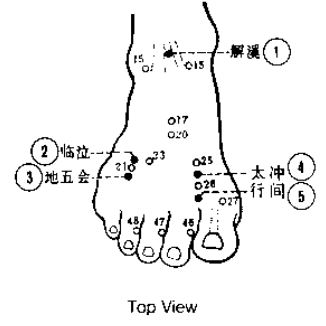
#20
3 units proximal to mid-point of line between the 2nd and 3rd metatarsal bones on dorsum of foot. 足背第 2 蹠骨與第 3 蹠骨連線中點近端 3 寸。
Needling Method: Straight insertion or slanted superiorly, 2 units. 進針方式:直刺或斜上,2寸
#46
At border of light and dark skin on medial aspect of 2nd interphalangeal joint of 2nd toe.第二腳趾第二指間關節內側淺色皮膚與深色皮膚交界處。
Needling Method: Prick 0.1-0.3 unit. 進針方式:點刺0.1-0.3寸
#47
At border of light and dark skin on medial aspect of 2nd interphalangeal joint of 3rd toe. 第三趾第二指間關節內側淺色皮膚與深色皮膚交界處。
Needling Method: Prick 0.1-0.3 unit. 進針方式:點刺0.1-0.3寸
#48
At border of light and dark skin on medial aspect of 2nd interphalangeal joint of 4th toe. 第四趾第二指間關節內側淺色皮膚與深色皮膚交界處。
Needling Method: Prick 0.1-0.3 unit. 進針方式:點刺0.1-0.3寸
Other prescriptions
- Head Wind: DU-23 (Shangxing), DU-21 (Qianding), DU-20(Baihui), SI-5 (Yanggu),LI-4 (Hegu), TB-1 (Guanchong), BL-60 (Kunlun) and GB43 (Xiaxi). 頭風: 上星、前頂、百會、陽谷、合谷、關衝、崑崙、俠溪 (Source: CDR)
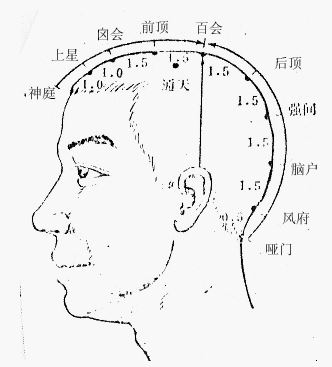
DU-23 (Shangxing)上星:
One inch behind the hairline in front of the midline of the head.頭頂正中線前髮際後一寸處。
DU-21 (Qianding)前頂:
In front of the midline of the head, 3.5 inches behind the hairline, and 1.5 inches in front of Baihui.頭頂正中線前髮際後三寸五分處,百會前一寸五分。
DU-20(Baihui)百會:
At the midline of the head, 5 inches behind the front hairline, about the tip of the two ears straight up to the center of the head. 頭頂正中線前髮際後5寸處,約兩耳尖直上頭頂中央。
DU-19 (Houding)後頂:
At the midline of the head, 5.5 inches above the back hairline, 1.5 inches behind Baihui.頭頂正中線後髮際上5.5寸,百會後1.5寸。
2. Head Wind with vertex pain: DU-20(Baihui百會, DU-19 (Houding後頂), andLI-4 (Hegu合谷). (Source:GCAM)
3. Lateral or midline headache: Moxibustion at GB-19 (Naokong), GB-20 (Fengchi), LU-7(Lieque), LU-9 (Taiyuan),LI-4 (Hegu), and ST-41 (Jiexi). 側頭痛或中線頭痛:腦空、風池、列缺、太淵、合谷、解溪(Source: PDM)
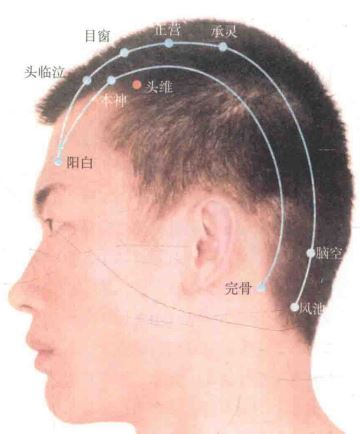
GB-19 (Naokong)腦空
On the head, horizontally parallel to the upper edge of the external occipital protuberance, and straight up fromGB-20 (Fengchi). Acupuncture flattly 0.5-0.8 units.在頭部,橫平枕外隆凸的上緣,風池直上。平刺0.5-0.8寸。
GB-16 (Muchuang)目窗:
On the head, 1.5 inches above the front hairline, with pupils straight upward.在頭部,前髮際上1.5寸,瞳孔直上。
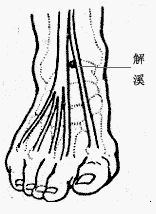
ST-41 (Jiexi)解溪
In the central depression of the transverse crease at the junction of the dorsum of the foot and the calf, between the extensor pollicis longus tendon and the extensor digitorum longus tendon.足背與小腿交界處的橫紋中央凹陷處,拇長伸肌腱與趾長伸肌腱之間。
4. If lateral head Wind includes the eyes and teeth, burn 21 cones of moxa at GB-19 (Naokong) and GB-16 (Muchuang). For pain on left side, apply moxa on the right, and vice versa. 若側頭風包括眼睛和牙齒,則在腦空和目窗處燃燒21炷艾。左側疼痛,可用右側艾灸,反之亦然。(Source:BBQS)
5. Headache with dizziness: LI-17 (Tianding), BL-12 (Fengmen), BL-60 (Kunlun), RN4(Guanyuan), and TB-1 (Guanchong). 頭痛頭暈:天鼎、風門、崑崙、關元、關衝 (Source: PUB)
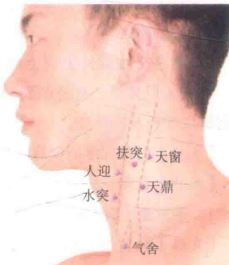
LI-17 (Tianding)天鼎:
In the neck, horizontally to the cricoid cartilage and posterior to the sternocleidomastoid muscle. Acupuncture straightly 0.5-0.8 units. 在頸部,橫平環狀軟骨,胸鎖乳突肌後緣。直刺0.5-0.8寸。
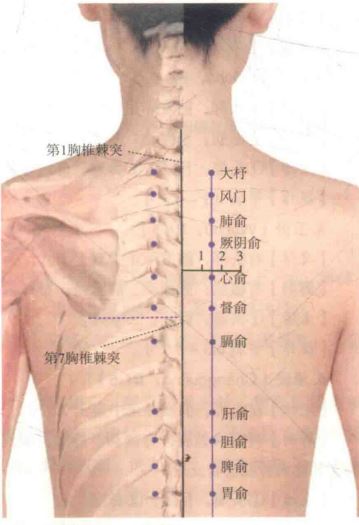
BL-12 (Fengmen)風門
1.5 units next to the position below the spinous process of the second thoracic vertebra on the back, approximately level with the upper corner of the scapula.背部第二胸椎棘突下旁開1.5寸處,約與肩胛骨上角相平。
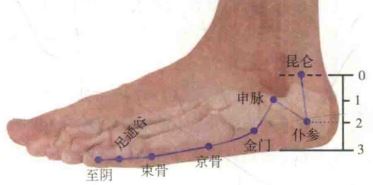
BL-60 (Kunlun)崑崙
Behind the lateral malleolus of the foot, in the depression between the tip of the lateral malleolus and the Achilles tendon.足部外踝後方,外踝尖與跟腱之間凹陷處。
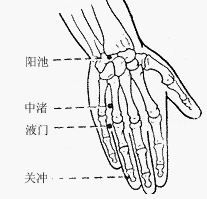
TB-1 (Guanchong)關衝 (Source: PUB)
在手指,第4指甲尺側根+側上方0.1寸。
Remarks
- Avoid deep insertion at DU-16 (Fengfu). If necessary, use a slanted insertion. Caution must also be observed if the physician chooses to join two points here with a transverse insertion.避免深度插入風府。如有必要,請使用斜刺。如果醫生選擇透過橫向透刺此處的兩個點,也必須小心。
- If the headache is due to hypertension, strong needle stimulation should be avoided. 如果是高血壓引起的頭痛,應避免強烈的針刺刺激。
- Acupuncture is relatively effective in treating this condition. However, the causes of headache are complex, and acupuncture treatment should be preceded by careful diagnosis to determine the source of the problem. Other modes of Chinese and Western medicine may therefore be needed in addition to acupuncture, in order to treat the root cause.針灸治療這種情況相對有效。然而,頭痛的原因很複雜,針灸治療前應仔細診斷,以確定問題的根源。因此,除了針灸之外,可能還需要其他中西醫結合的方法,才能從根源治療。
- Manipulation and breathing exercises (Qigong) have proven effective in the treatment of chronic headache and are therefore recommended in conjunction with acupuncture therapy. 手法和呼吸練習(氣功)已被證明對治療慢性頭痛有效,因此建議與針灸療法結合使用。
Reference:
 Jade Health Acupuncture
Leave a comment